
Blueprint for Revolution, by Srdja Popovic
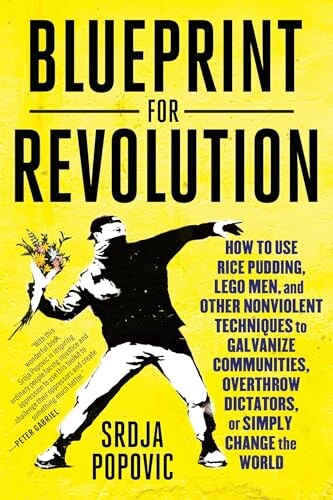
“This is a book about revolutions. Not the violent kind: those usually end up soaked in the blood of innocent people. And not the type carried forth by a small group of zealots: if you wonder how those work out, curl up with a good biography of Lenin. Instead, this is a book about the kind of movements that are now sweeping through so much of the world, from Cairo’s Tahrir Square to Occupy Wall Street. It’s a book about the revolutions launched by ordinary people who believe that if they get together and think creatively, they can topple dictators and correct injustices.
“I had the good fortune of being one of those ordinary revolutionaries, and I traveled on a strange personal journey from a too-cool-to-care Belgrade bass guitarist to one of the leaders of Otpor!, the nonviolent movement that toppled the Serbian dictator Slobodan Milošević. After a brief stint as a member of the Serbian parliament, I now work as a friend and consultant to any movement, large or small, anywhere in the world, that wishes to apply the principles of nonviolent action to oppose oppression and bring about liberty, democracy, and joy. But don’t worry: this book isn’t about me. Instead, it’s about all the things I’ve learned while working with activists from Syria to Kiev, about the big ideas and the small tactics that make what I like to call “people power” such a mighty force. Because I’m no great intellectual, I’ve chosen to convey most of this information not with dry facts or dense theories but by simply telling stories of remarkable individuals and movements, the challenges they faced, and the lessons they learned.” (Blueprint for Revolution, Preface by Srdja Popovic)
This reading series will be integrated into the Book Club program upon its completion.
Chapters
Chapter I: It Can Never Happen Here
Chapter II: Dream Big, Start Small
Chapter III: Vision of Tomorrow
Chapter IV: The Almighty Pillars of Power
Chapter V: Laugh Your Way to Victory
Chapter VI: Make Oppression Backfire
Chapter VII: It’s Unity, Stupid!
Chapter VIII: Plan Your Way to Victory
Chapter IX: The Demons of Violence
Chapter X: Finish What You Started
Chapter XI: It Had to Be You
Democracy Incorporated, by Sheldon Wolin

“Democracy is struggling in America — by now this statement is almost cliché. But what if the country is no longer a democracy at all? In Democracy Incorporated, Sheldon Wolin considers the unthinkable: has America unwittingly morphed into a new and strange kind of political hybrid, one where economic and state powers are conjoined and virtually unbridled? Can the nation check its descent into what the author terms ‘inverted totalitarianism’?
“Wolin portrays a country where citizens are politically uninterested and submissive — and where elites are eager to keep them that way. At best the nation has become a “managed democracy” where the public is shepherded, not sovereign. At worst it is a place where corporate power no longer answers to state controls. Wolin makes clear that today’s America is in no way morally or politically comparable to totalitarian states like Nazi Germany, yet he warns that unchecked economic power risks verging on total power and has its own unnerving pathologies. Wolin examines the myths and mythmaking that justify today’s politics, the quest for an ever-expanding economy, and the perverse attractions of an endless war on terror. He argues passionately that democracy’s best hope lies in citizens themselves learning anew to exercise power at the local level.” (Overview, Princeton University Press)
Would you like to study this book with others? Join a group.
Chapters
Ch. 2: Beginnings of the Imaginary of a Permanent Global War
Ch. 4: The New World of Terror
Ch. 5: The Utopian Theory of Superpower: The Official Version
Ch. 6: The Dynamics of Transformation
Ch. 7: The Dynamics of the Archaic
Ch. 8: The Politics of Superpower: Managed Democracy
Ch. 9: Intellectual Elites against Democracy
Ch. 10: Domestic Politics in the Era of Superpower and Empire
Ch. 11: Inverted Totalitarianism: Antecedents and Precedents
Doughnut Economics, by Kate Raworth

“Faced with a multifaceted crisis – the capture of governments by billionaires and their lobbyists, extreme inequality, the rise of demagogues, above all the collapse of the living world – those to whom we look for leadership appear stunned, voiceless, clueless. Even if they had the courage to act, they have no idea what to do.
“The most they tend to offer is more economic growth: the fairy dust supposed to make all the bad stuff disappear. Never mind that it drives ecological destruction; that it has failed to relieve structural unemployment or soaring inequality; that, in some recent years, almost all the increment in incomes has been harvested by the top 1%. As values, principles and moral purpose are lost, the promise of growth is all that’s left.
“. . . We cannot hope to address our predicament without a new worldview. We cannot use the models that caused our crises to solve them. We need to reframe the problem. This is what the most inspiring book published so far this year has done.” (Finally, a breakthrough alternative to growth economics – the doughnut. George Monbiot, The Guardian, Wed 12 Apr 2017)
Would you like to study this book with others? Join a group.
Chapters
INTRODUCTION: Who Wants to Be an Economist?
Ch. 1: CHANGE THE GOAL – From GDP to the Doughnut
Ch. 2: SEE THE BIG PICTURE – From self-contained market to embedded economy
Ch. 3: NURTURE HUMAN NATURE – From rational economic man to social adaptable humans
Ch. 4: GET SAVVY WITH SYSTEMS – From mechanical equilibrium to dynamic complexity
Ch. 5: DESIGN TO DISTRIBUTE – From “growth will even it up again” to distributive by design
Ch. 6: CREATE TO REGENERATE – From “growth will clean it up again” to regenerative by design
Ch. 7: BE AGNOSTIC ABOUT GROWTH – From growth addicted to growth agnostic
Less is More, by Jason Hickel

“The world has finally awoken to the reality of climate breakdown and ecological collapse. Now we must face up to its primary cause. Capitalism demands perpetual expansion, which is devastating the living world. There is only one solution that will lead to meaningful and immediate change: degrowth.
“If we want to have a shot at halting the crisis, we need to slow down and restore the balance. We need to change how we see nature and our place in it, shifting from a philosophy of domination and extraction to one that’s rooted in reciprocity and regeneration. We need to evolve beyond the dogmas of capitalism to a new system that’s fit for the twenty-first century.
“But what about jobs? What about health? What about progress? This book tackles these questions and offers an inspiring vision for what a post-capitalist economy could look like. An economy that’s more just, more caring, and more fun. An economy that will not only lift us out of our current crisis, but also restore our sense of connection to a world that’s brimming with life. By taking less, we can become more.” (Source: https://www.jasonhickel.org/less-is-more)
Would you like to study this book with others? Join a group.
Chapters
INTRODUCTION: Welcome to the Anthropocene
Part One: More is Less
ONE: Capitalism – A Creation Story
THREE: Will Technology Save Us?
Part Two: Less is More
FOUR: Secrets of the Good Life