

Whatever Israel does, it enjoys military support and diplomatic cover from Western powers. What are the roots of this delusional state of mind, and how can democratic principles prevail for the good of all?
Gaza – A Case Study
1. Duplicity
2. Genocide
3. Colonialism
Western Complicity
1. Talking Points
2. Double Standard
3. Silencing Dissent
The Zionist Fraud
1. History and Myths
2. Hasbara and Lobbying
3. Authoritarian Collusions
Fighting For Democracy
1. Holding to Principles
2. Resisting the Empire
3. A People’s Future
This table will be activated as the post’s content is published.
Gaza – A Case Study
1. Duplicity
- Us and Them
- Being at War
- Endgame
Us and Them
The Hundred Years’ War on Palestine
Common wisdom among Israel’s supporters and allies is that since it is a democracy, the country necessarily fights the good fight and only defends itself against its aggressors. This is forgetting that Zionism—Israel’s foundational principle—runs at the exact opposite of the democratic ideal. The country is a settler colonial project based on religious identity; full citizenship is granted to Jews wherever they come from, whereas natives are either second-class citizens or live under occupation while being continuously dispossessed of their homes and land. Whether at a low or high level of intensity, war is thus inherent to Zionism’s colonial endeavor, whose violent history did not start on October 7th, 2023, with Hamas’ coordinated attack in southern Israel.
Since that fateful day, however, the genuine perspective of the Israeli-Palestinian conflict has revealed itself in a crude light. Not only have Gazans been the target of an avowed genocidal intent; Israeli settlers in the West Bank, emboldened by their government’s explicit intent to annex the whole territory, have harassed, killed, and stolen Palestinian properties at an unprecedented rate. Confirming that Palestinians do not matter, the present Israeli government has eventually made clear that it will never allow a Palestinian state to exist.
As it has always done, Israel claims that its survival is at stake. But its survival as what? Democracy is founded upon universal and unconditional moral principles; how could it prevail through the indefinite and exclusive use of violence? If, moreover, it genuinely were about Israel’s security, peace would have been built long ago with the Palestinians, notably after their political leader, Yasser Arafat (1929–2004), formally recognized the existence of Israel in 1988.1 Instead, Israeli officials have constantly implied that no goodwill is possible on the other side. This attitude has only confirmed that a colonial endeavor is fundamentally at odds with elevating the exercise of power to the genuine political level that defines relationships among free men. Countries like the United States, New Zealand, or Australia have eventually departed from their original colonial stance; why should it be fundamentally different with Israel? How can the right of Palestinians to a viable territorial space on their ancestors’ land be a seemingly unsolvable issue?

At some point, Yitzhak Rabin (1922–1995) tried to convey to Israelis that security and prosperity for them need not and could not be equated with depriving Palestinians of the same rights. In complete denial mode, hard-core Zionists came back with revenge. In a sense, they were right: You either are a Zionist or you are not. There is no compromise to be had for nationalism, whatever the color it takes. Zionism, for its part, seized upon the long history of persecution against Jews to enter the upside-down logic of nationalism, building a country on fear—that is to say, on the negation of the other. For Zionists as for anyone subdued by the image of a dualistic world opposing “us” and “them,” the other is just that, and consequently a threat. In this view, you are forced to strike first if you do not want to be overwhelmed. Whether against immigrants, a foreign country, or natives on a coveted land, the psychological pattern that makes the aggressor the victim is always the same.
Unfortunately, Zionism is also “Israel’s allies'” blind spot. Colonialism is an old story that the Western world would rather forget. For this reason, it is understandably reluctant to recognize white supremacy’s long historical trend in the mirror held by Israel to its proclaimed allies. Instead, they assume that the country they helped create after WWII can only, by contrast with the Shoah, be founded on moral values. As such, however, this cheap psychological band-aid on their guilt only perpetuates the same irresponsibility that led to the Shoah in the first place. Western countries keep willfully ignoring that you cannot repair a crime—letting millions of Jews go to their death—with an injustice—depriving Palestinians of their land. Still, after having looked away at the first alarming signs of Nazi barbarity in the 1920s and 1930s, these same countries have bought the Zionist lunacy that the defense of Jews against persecution requires the existence of a Jewish state. Conferring Israel a moral status that is out of this world, “Israel’s allies” have since then accustomed themselves to relegating to the infamy of antisemitism those who oppose its steady encroachments on Palestinian lives.

What are the historical origins of this moral and intellectual collapse? The project of clearing what was known as Palestine of its native Arab population was first laid out by Theodor Herzl (1860–1904), saying, “We must expropriate gently the private property on the estates assigned to us. We shall try to spirit the penniless population across the border by procuring employment for it in the transit countries, while denying it employment in our own country. The property owners will come over to our side. Both the process of expropriation and the removal of the poor must be carried out discreetly and circumspectly.”2 Rashid Ismail Khalidi, Palestinian-American historian of the Middle East and Professor Emeritus of Modern Arab Studies at Columbia University, thus makes clear that “Although Herzl stressed in his writings that his project was based on ‘the highest tolerance’ with full rights for all, what was meant was no more than toleration of any minorities that might remain after the rest had been moved elsewhere.”3
The eventual collapse of the Ottoman Empire after WWI prompted Great Britain to allegedly act in support of the Zionist cause by establishing a British mandate over Palestine. As Eugene Rogan, Professor of Modern Middle Eastern History at Oxford University, explains, this offered Britain two main strategic advantages. First, it could “stake its claim to Palestine not in terms of its selfish imperial interests, but as a matter of historic social justice – resolving Europe’s ‘Jewish Question’ through the return of the Jewish people to their biblical homeland.” Second, “Totally dependent on the British for their position in Palestine, the Zionists would be reliable partners in managing the mandate against the predictable opposition of the Palestinian Arab majority.”4
The Balfour Declaration of 1917 formalized the establishment of a “national home for the Jewish people” and was later incorporated into the British Mandate for Palestine (1923-1948). A “home” is not a state. Still, imposed on a majority Palestinian population who had not had difficulties living alongside Jews and Christians for a very long time, it legitimately felt like colonial overreach. Not only did Palestinians have no say in the re-establishment of a Jewish nation (“home”) on Biblical land, but it was certain that Zionists would not miss the opportunity to turn this territorial right into the creation of a Jewish state. This was their whole point.
The fourth Palestine Arab Congress consequently voted to send a six-man delegation to London in August–November 1921, demanding that the Balfour Declaration be repudiated. They proposed instead the creation of a national government with a democratically elected parliament representing the country’s Muslims, Christians, and Jews.5 Alarmed by the prospect of a solution that was morally decent and politically sound but went against its colonial interests, the British government issued a white paper in June 1922,6 declaring that Great Britain did not “contemplate that Palestine as a whole should be converted into a Jewish National Home, but that such a Home should be founded in Palestine.” This was, in fact, the admission that colonialism is war and that war is a lie. Palestinians were taken for fools who could not grasp the true nature of the Zionist project, and, as colonialism goes, for sub-humans who have no right to decide for themselves.7
Great Britain had its colonial arrogance; Zionists had a goal. It was just a matter of time before they kicked their British allies out and accomplished it. As for Palestinians, deemed unworthy of self-determination from the get-go, they had logically become the by-default cause of eventual tensions. How could these people keep opposing what was decided in their place and fail to understand the superior wisdom of benevolent world-rulers? Winston Churchill would famously confirm this view while speaking to the Palestine Royal Commission in 1937, saying, “I do not agree that the dog in a manger has the final right to the manger even though he may have lain there for a very long time. I do not admit that right. I do not admit for instance, that a great wrong has been done to the Red Indians of America or the black people of Australia. I do not admit that a wrong has been done to these people by the fact that a stronger race, a higher-grade race, a more worldly wise race to put it that way, has come in and taken their place.”8
Times change. Overt bigotry cannot justify Western powers’ prepotence anymore; instead, they now rely on shameless duplicity about democratic values. Yet, saying that the situation is “complicated” regarding the Israel-Palestinian conflict no longer cuts it either. Our “democracies” show their true colors by allowing in Gaza what experts have overwhelmingly characterized as a genocide. Blatantly prioritizing power over justice, they also expose how the world at large operates. The unspeakable tragedy of Gaza is, therefore, everyone’s call to responsibility, using the right of Palestinians to self-determination as an inspiration to build together a better future for all.
Human animals
Given the little chance most of them had to come back alive, the Hamas militants who committed the slaughter of hundreds of Israelis and abducted 251 people from Israel to the Gaza Strip on 10/07/23 likely were unmarried young men. This means that they had spent almost all of their lives in what some Israeli officials called a “concentration camp,” even before the intensity of the blockade was notched up by Israel when Hamas was elected as the governing body of the Gaza Strip in 2006.9
Nothing can justify what happened on 10/07/23, but the events of that day did not occur in a vacuum either. A blockade aims to create a state of deprivation, obstructing all opportunities for economic development and barring people from leaving the blocked area. Concerning the Gaza Strip, moreover, it had constantly been maintained at the highest level of severity possible, to the point that the Israeli administration used to joke about putting Gazans “on a diet” by periodically restricting food aid to the least amount of calories humanly viable.10
Another aspect is as crucial. Since Gazans were trapped in an open-air prison, they were also left at the mercy of their wardens. “Mowing the lawn” was another amusing way for the Israeli administration to label what it saw as a duty: the collective punishment of Gazans in retaliation for Hamas’ sporadic attacks on Israeli citizens. These killing sprees resulted in thousands of Palestinian deaths between 2008 and 2022. The blueprint of savagery had thus been handed down to the perpetrators of the 10/07/23 attack.
Deprived of a decent future and with no choice other than a slow or quick death under Israeli rule, many Gazan youths felt justified to follow their abuser’s path of violence. Though misguided, the thought is nevertheless human. Again, if the context can explain what happened on 10/07/23, nothing can justify it. Strangely, however, the Israeli government holds that this self-evident moral principle cannot be reciprocated. Nothing can justify the October 7th, 2023, killings by Hamas, yet the event of that day has justified everything in Gaza.
How can the universality of moral values be enforced in polar opposite ways? The former defense minister, Yoav Gallant, gave a straightforward answer on October 9, 2023, saying, “We are fighting human animals, and we are acting accordingly.” If words have meaning, these imply that Gazans are human in form only; as “human animals,” they are a species distinct from the rest of humanity. Whether or not Gallant was aware of voicing out the exact same insanity the Nazis used against Jews and other “degenerated” populations, the result is logically identical—the promise of a genocide.

Its first step, as declared by Yoav Gallant that day: “I have ordered a complete siege on the Gaza Strip. There will be no electricity, no food, no fuel, everything is closed.” Since then, the whole world has witnessed that an effective eradication process was to be carried out until “total victory.” In a classical way, this process is threefold: 1/ continuously shelling an entire civilian population (including in designated “safe zones”), 2/ ensuring their starvation, and 3/ waiting for the spread of diseases, due to the destruction of all sanitary infrastructures, to weaken and eventually annihilate most people in the Gaza Strip, starting with children.
As Ret. Major General Giora Eiland once explained, the goal is to fight evil at its root by depriving Gazans of the ability to raise new “little snakes,” adding, “this is not about cruelty for cruelty’s sake since we don’t support the suffering of the other side as an end but as a means.”11 A purely rhetorical distinction for women and children in Gaza, and one that Paul Joseph Goebbels had fully embraced before Giora Eiland regarding the alleged necessity of genocide.
More broadly, the trauma of 10/07/23 cannot explain the slaughter of civilians in Gaza for months on end. Far more than a gut reaction motivated by pure outrage, this is the expression of a deliberate policy, a means to the end of “finish the job.” Widely used by Israelis in regard to the “war” in Gaza, this phrase refers to the 1948 Nakba, when around 750,000 predominantly Arab people were violently expelled from their homes.12 In other words, the genocide orchestrated in Gaza is a mere shortcut to a long-held goal of ethnic cleansing, wrapped under the pretext of “security.” Those who wish to pretend that Hamas is specifically targeted, even though their eyes show them something entirely different, have a ready-made excuse: In Gaza, everybody is Hamas. In the meantime, there is no doubt that the enthusiasm for the “job” started by the IDF in the 1940s is as high as ever when watching the sick videos shared by Israeli soldiers on social media.

In a sense, “human animals” says it all. Wantonly massacring people by the tens or hundreds of thousands cannot be done without considering their lives as worthless.13 Of course, Yitzhak Herzog, Yoav Gallant, or Benyamin Netanyahu would vehemently protest that they are not racist bigots who seriously believe that there are “human animals” living alongside real humans. Their problem, then, is that they do not believe in logic either. If we are all humans, the assumption that there are no innocent Palestinians, as President Herzog sternly stated, immediately begs for an answer to the following question: Why should there be innocent Israelis in the eyes of Palestinians? Wouldn’t the same type of hallucinated conclusion find even more apparent legitimacy in what has been done to them for decades in the Israelis’ name? As for Hamas, how can one lament after 10/07/2023 that the organization failed the most basic principles of morality when the Israeli government had maintained an entire population of 2.3 million people for 17 years, by then, at the mercy of its wrath and, moreover, under a state of harsh and humiliating deprivation?
It thus appears that the commanders of “the most moral army in the world” also rank as the most intellectually dishonest people on the planet. It would only take them to look at numbers to leave their righteous moral high ground. 7,118 Palestinians were killed by the IDF in the four assaults on Gaza between 2008 and 2021, compared to 344 Israelis.14 When the most potent contender kills 20 times more on average, how can it feign surprise that its lesson is duly taken?
The civilized ones

Seen many times against Hamas and Hezbollah over the years, disproportionate retaliation was notably formalized as the Dahiya doctrine15 by former Israel Defense Forces (IDF) Chief of General Staff Gadi Eizenkot during the 2006 Lebanon War. The logic is to cause such difficulties and harm to the civilian population that they will, supposedly, have no choice but to turn against the fighters in their midst, forcing them to stop hostilities.
Of course, one would be hard-pressed to find a rational justification for the hope that using violence far beyond the practical necessity of self-defense will, somehow, deter violence. But the official answer is that this is missing the point. Since Israeli headquarters consider that anti-semitism is the poison fuelling attacks on the country, “teaching a lesson” is not using violence for the sake of violence; it is telling aggressors that, one way or another, their only option is to change course. Due to its particular status as a Jewish state, it is assumed that Israel has no choice but to resort to disproportionate retaliation to keep the beast of antisemitism in check. This is why all of its battles are said to be existential ones.
Yet, though it is true that Hezbollah or Hamas officials have regularly engaged in Holocaust denial and spread anti-Semitic conspiracy theories in the name of their political stand against Zionism, this does not necessarily make them Hitler’s little replicas. Like racism, antisemitism is not a monolith. Some will be antisemitic by the implications of their words or attitude without even noticing, sincerely convinced they are true humanists; others will passively accept bigoted mental schemes because they lack the courage to think for themselves; others still will overtly claim their hatred of Jews. There are degrees in stupidity, and no one could deny that the human psyche is a mixed reality.
Aside from clinical cases of dementia, everyone can always choose to think. Before being a violent cultural undercurrent that has plagued many societies, anti-semitism is simply dumb. Education is the cure. Strangely, however, the Dahiya doctrine tells us that it is not, and that anti-semitism, like cancer, cannot be cured from within the malignant cells; it can only be removed. Which means blasting all possibilities of the anti-semitic cancer to spread. But officially disregarding the rule of proportionality between military targets and civilians as a matter of strategy is a war crime. Lying on the principle that the sacredness of human lives, notably innocent ones, can be disregarded, its justifications are mere pretexts to end a conflict through utter destruction.
Ironically, by implying that some people just cannot think and that, consequently, goodwill can never be expected from them, the Dahiya doctrine, or whatever its avatars might be called today, promotes the abandonment of reason. What is at stake under its veneer of rationality is the self-serving and self-reinforcing conviction that the enemy is just that—nothing more than an indiscriminate hostile mass, not people.
Indulging in the belief that some, because they come from a different cultural background, do not have the ability to behave like real humans is the definition of racism. At a collective level, this is a civilizational dead end where the alleged civilized ones not only make a mockery of reason but demonstrate their own entrenched barbarity.
Most Israelis have no qualms about being racist. Not because they are born bad people, but because you cannot be a colony without opposing your own sense of self-worth to the inferiority of those you colonize. In that sense, dehumanizing Palestinians does not proceed, first and foremost, from a personal intent; in the framework of colonialism, it is a collective necessity. If the formal crafting of a so-called “Dahiya doctrine” is any indication in this regard, it is that Israeli headquarters have long admitted that their use of violence is not about something that could ultimately be rationally defended, but something that bears no questioning. Violence becomes speech, symbolically telling Palestinians that there is nothing they are morally entitled to argue about. In typical colonial fashion, the more bullets and missiles fired at them, the clearer the subliminal message that “human animals” should know their place.
In the context of the open colonial war led since 1948 by an Israeli state that never found the resources to think of itself as anything other than Zionist, phrases such as “human animals” or “vermin” merely echo the old European belief that natives on “uncivilized” conquered land were unfit for self-determination. They could allegedly only be brought to reason, not reason themselves. Coercing them was thus legitimate, and using violence was a necessary evil against unruly savages prone to it.
This racist fantasy has legitimized European colonization for hundreds of years, purporting that those at the height of humanity’s achievements did a favor for those who, by contrast, lacked technology, written knowledge, and modern legal and political institutions. Common wisdom was thus that if it weren’t for the white man, natives would scrape by indefinitely in their ancestral way, unable to learn anything else. It was only in the second half of the twentieth century that scientific advances in history, anthropology, sociology, and psychology definitively debunked this heavily biased, far too narrow concept of civilization.
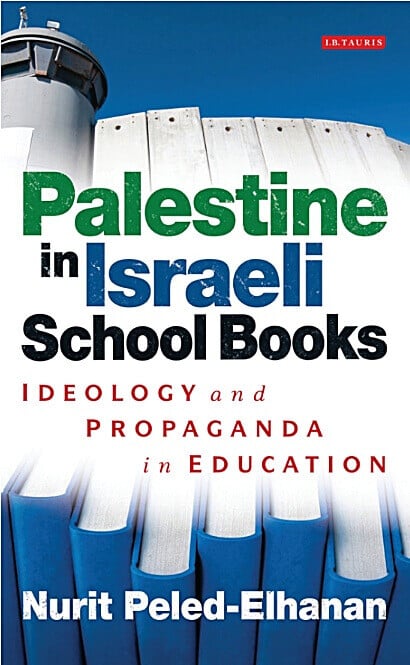
This, however, has not mattered much to the Zionist colonial dynamic. Though Palestinians have inherited the cultural brilliance of the Arabic civilization, and Gaza used to be the most educated place in the world in proportion to its population, Israeli schoolbooks still stick to the image of them as “Arabs,” pictured never too far away from a camel or some other sign of a backward way of living.
In reality, tacitly starting with the gain in mind, the mental scheme of colonization reverses both logic and morality, using the argument of intellectual and civilizational superiority as an unquestioned premise. Merely signaling an entrenched sense of entitlement that is beyond any rational justification, this premise triggers a stream of excuses, pretexts, and false reasoning whenever it is challenged. The point, there also, is not to produce a rationally valid argument but to look good in one’s eyes.
Tragically, as words cannot make sense in what amounts to nothing more than an incantatory process, the more colonial claims are questioned and opposed, the more violently colonizers will defend them. This is why, in a contemporary echo to that same colonial mentality, we were told after October 7th, 2023, that there is no “moral equivalence” between Hamas killing Israelis and the IDF killing Gazans, even though at a much higher rate. In other words, when Hamas kills, it is terrorism; when the IDF does, it is self-defense. Why? Because on one side is the enraged violence of savages; on the other, the innocence of civilization bearers. How could anyone miss that?
In line with this intellectual vacuity is the systematic reliance on the “human shields” argument. The British initiated the practice during the Palestinian revolts at the end of the 1930s, which mostly consisted of tying up someone on the hood of a military truck to minimize the risk of an attack. Hamas militants don’t really have such opportunities, but the IDF does during its prolonged incursions on Palestinian soil, and has regularly used them.16
If words have meaning, “human shields” thus specifically refers to using individuals as such during fire exchanges or incursions into enemy territory. A population, on the other hand, is just there; at no point can it constitute a “human shield,” let alone at all times. Yet, not only does the Israeli propaganda deny that the IDF could commit what squarely amounts to a war crime, but it explicitly says that Hamas—somehow by the mere fact that its militants live among the population—is the exclusive and systematic culprit in this regard.
There again, the purpose is not to make sense. Rather, it is to reap the significant benefits of a blatant lie. First, disingenuously blowing the fantastical image of demonic enemies having no qualms about getting their own families killed is warfare 101. Since an image has a far more powerful psychological impact on the masses than a concept, repeating its related slogan ad nauseam is a weapon of choice. Second, if “human shields” are any part of the population anywhere in Gaza and at any time, Israeli headquarters are then exonerated from the rule of proportionality in military actions. All the while, Hamas is conveniently made directly responsible for the crimes that the IDF commits. Last but not least, a sordid arithmetic can take place where the number of civilian deaths is presented as a sad but relevant estimation of the weakening of Hamas’ capabilities.
Many Israelis do not think otherwise. To them, if Hamas nefariously hides among the population of Gaza, piercing through as many shields as it takes to defeat terrorism is not a choice; it is a necessity. Confronted with this cynical and flawed reasoning, one cannot help wondering: What if they were themselves labelled as their government’s “human shields” by some other powerful military force, and if their own families were the slaughtered ones? Would it still make sense to these righteous but superficial minds to consider entire populations as mere “shields”?
The “terrorist” card
To this day, Israeli citizens are effectively supposed to be able to enjoy peace, security, and freedom only if these fundamental human rights are simultaneously denied to Palestinians. Though this is an awkward position to be in regarding the universality of moral principles, forcing a square peg into a round hole has officially been a no-brainer to all successive Israeli governments: Israelis are the innocent victims of retarded savages who just “hate us.”
This makes no sense outside a colonial context, where denying natives their right to self-determination is an existential matter for the system put in place. Preventing them from being recognized as serious and honest interlocutors is thus crucial. They “hate us” for no reason, just by being who they are, not because their land, their dignity, and their lives have been stolen from them. It follows that when fighting for justice, natives aren’t political opponents but “terrorists,” a label implicitly but conveniently implying that this is all there is to know about them. By the same token, either through jail or physical elimination, their disappearance from view is the only sensible outcome.
This is why playing the terrorist card is a no-brainer for all forms of authoritarian governments, including colonial ones. Intentionally vague but emotionally powerful, it can be used pretty extensively. After all, Nelson Mandela stayed in jail for 27 years because he was allegedly a terrorist.17 But his example also shows that the strength of the terrorist card is also its weakness. Emotionally rallying people or instilling fear is, on the part of a government, playing on the unknown, which is fraught with inconsistencies. Let’s look at three main ones.
First, all resistance movements anywhere in the world have, at one point or another, been designated as terrorists. Whether innocent people are killed or not, if you bear arms to fight for your cause, you are prone to end up as a terrorist in the eyes of anyone who does not share your views. According to their propaganda, the Nazis were also fighting terrorism during WWII, when confronted with patriots from the countries they had invaded.

Second, if the definition of terrorism is, literally, to inflict terror, state terrorism can then turn out to be significantly more efficient than loose networks of fanaticized individuals. A state has institutional legitimacy, which, for many citizens, grants free rein regarding the means used to subdue an alleged enemy. A state, moreover, has the firepower of an army at its disposal. And when its objectives are deemed of national interest, it also has time on its side. All this makes a significant difference with a bunch of lunatics using terror as a means to their political or religious ends. In one case, terrorists hide away from sight to kill random people when they can; in the other, an official entity, such as the Israeli government in Gaza, decides to bomb an entire population for as long as it pleases—an achievement far beyond the reach of any terrorist NGO ever to exist.
The third inconsistency lies in the government’s justification for such acts. If security is the goal, why indiscriminately reject as “terrorist” anyone who is determined to stand for their basic rights? How will Israelis, for one, ever feel safe if peace is not built? Unless, of course, security is not the goal, but power.
Peace requires justice, which a colonial entity cannot accept. It consequently needs to resort to violence not just as an immediate answer, but also as a bait for natives. Played well, the terrorist card will provide endless justifications for retaliation while blocking any peace process. The game is won, in that perspective, when all competent and well-intentioned voices on the other side are either physically eliminated or driven to desperation. Its rule is that peace is what you want, not what justice wants.
A rogue state does not want to be compelled to try to justify its murderous bullying before opponents with moral and intellectual clarity. This is why Netanyahu favored Hamas anyway he could for years,18 finding in them a much better pretext to fight a war to no end than with the Palestinian Authority. In the process, the negotiations for a two-state solution would be indefinitely put on hold, while the real threat—Gazans willing to join the Palestinian Authority for building a just peace with Israel—would be steadily diminished.
From an aggressor’s standpoint, peace is defeat. Why would you go to war if you admit that there are serious interlocutors on the other side? The point is to fabricate an “enemy,” a formless entity whose defining characteristic is to live in a parallel universe from yours. This is how Israel uses the pretext of actual terrorist attacks to annihilate the lives and livelihoods of an entire population that it contends does not belong to the land anyway.
Indeed, even though the present administration is undoubtedly more open and brutal about its endgame than others in the past, all Israeli governments have systematically tackled the Palestinian issue, first and foremost, as a terrorist one. This has not only been the alleged reason for constantly refusing direct negotiations with Palestinian representatives but has also shaped the optics of what is to be discussed. Officially considering Palestinians as irrational actors always susceptible to fits of blind violence implies that their claims are likely as unfounded as their actions. By contrast, Israeli concessions appear as expressions of pure goodwill and generosity. And yet, taking advantage of a position of strength to dishonestly assert the terms of the debate is nothing more than bullying practiced by grown-ups.
The terrorist card has, therefore, deep historical roots, and it is not at all that surprising that actual terrorists would project on others what they do. The word “terrorists” follows the same logic that relegated “savages” to the fringe of humanity in earlier times. Their supposed human, cultural, and political insignificance allowed colonial powers to reap, with a good conscience and solemn demeanor, the practical benefits they had sought from the start.
But words have definite meanings, and one’s duplicity can only go so far when using them as mere labels. If, according to the US National Institute of Justice, “Terrorists are those who support or commit ideologically motivated violence to further political, social, or religious goals,”19 then the definition squarely applies both to Hamas and the Zionist movement since their creation. It does not apply, however, to the overwhelming majority of Palestinians in Gaza and in the West Bank, who long for peace—and certainly not to children.
Being at War
“War against Hamas”
In a conventional sense, war is defined as armies facing each other on the same battlefield with similar means of destruction. It doesn’t take a military genius to figure that thirty to forty thousand Hamas fighters (originally) with machine guns and rockets were no match against an army with tanks, missiles, and fighter jets, backed by hundreds of thousands of reservists, and supported by the best intelligence service in the world.
Another essential aspect of war is that it is supposed to respect proportionality between military targets and collateral damage to civilians. At some point, Netanyahu said that the IDF had achieved the “lowest ratio of civilian to combatant deaths in the history of modern urban warfare—it’s 1 to 1.”20 Beyond the fact that this is, in itself, an appalling ratio, it seems odd to call “urban warfare” what everyone can witness as the levelling of all urban infrastructures and the mass killing of unarmed civilians. According to data from the Israeli intelligence services, the actual ratio of civilian to combatant deaths in the Gaza Strip between October 2023 and May 2025 is at least 83 percent civilians.21 Besides, when, for example, an investigation was done in 2024 by the Israeli newspaper Haaretz about one instance of mass killing in the Netzarim Corridor, it found that among the 200 “terrorists” the IDF spokesperson labelled as such, only 10 could be verified as Hamas operatives.22
War is the realm of uncertainty, according to the Prussian military analyst Carl von Clausewitz (1780 – 1831). The fact is that what we are used to referring to today as the “fog of war” is particularly thick in Western mainstream media. Where is the “war” when the operations conducted on the ground merely amount to an abhorrent and perfectly illegal onslaught on trapped civilians? Yet, “war against Hamas” or “war in Gaza” is the mantra repeated by most pundits and politicians when mentioning the situation.
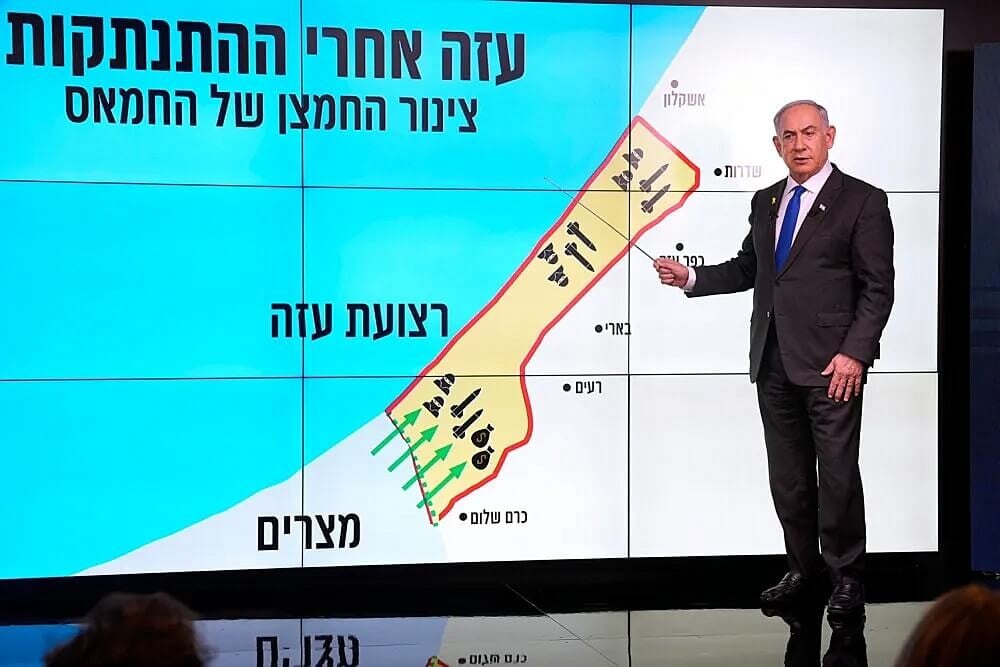
Since the first weapon of war is propaganda, the fact that the word “war” has lost its meaning signals, in reality, the Israeli headquarters’ most significant victory. The spontaneous mental image of “war” is that of fire and fury, of young people in military gear going at each other’s throats anyway they can, under the orders of higher-ranked personnel. This imagery conveys the assumption that the fighting parties have each a chance to win battles, and possibly the war. Being at “war,” they implicitly are on an equal footing in their capacity to undermine each other’s forces. This is the image Israeli headquarters need to convey to continue their “war” with some semblance of credibility, thus absurdly pushing the idea that military operations are the only way to prevent, once and for all, Hamas from striking again on Israeli soil.
To better understand the fallacy of such an argument and the real intention behind it, we have to take them at their word and confront the goal of defeating a terrorist organization with the material, tactical, and strategic aspects of military engagement.
Though Hamas likes to parade as an army, materially speaking, its weaponry merely allows for skirmishes against Israeli soldiers in Gaza and rocket strikes on Israeli cities; nothing close to incapacitating a real army, let alone one of the most sophisticated and well-equipped in the world. Locked behind the fences and surveillance system surrounding the Gaza Strip, Hamas could not even adopt a sustained guerrilla tactic on Israeli soil. Before October 7th, 2023, all the damage it had been able to cause was through suicide bombings and random attacks by individuals, often teenagers, who slipped through security checkpoints and were killed on the spot. How hundreds of militants were all of a sudden able to overcome the difficulty of getting out of Gaza, and kill Israelis for six hours before the IDF was on site, remains a mystery that the Israeli society still has to come to terms with.23
What tactical sense does it make to fight a network of individuals determined to resort to violence by carpet bombing the area where they are supposed to hide? One can easily oppose the uncertainty of their effective elimination to the certainty of the counter-productive effect on the population at large when entire families are wiped out. If the Israeli government does not care about breeding ever more terrorist vocations, this is one thing, but it cannot pretend at the same time to fight terrorism. Hamas is a network of indoctrinated young people, for whom, however desperate, armed resistance against Israel can still lead somewhere. It follows that if the goal of the Israeli government genuinely were to “uproot terrorism,” as so righteously proclaimed on any occasion, its tactic would then be threefold.
Individually targeting active terrorists for the immediate threat they represent is the first aspect. Unfortunately, the Israeli government shows it has no qualms about appearing as the terrorist-in-chief by mass-murdering people. The second aspect is to cut off as many of their organization’s financial resources as possible. For years, Netanyahu has done the exact opposite.24 The third and most decisive aspect is to undermine the terrorists’ cause by giving the populations they allegedly fight for a chance to live a decent life. Instead, the Gaza Strip was instantly put under a severe blockade once Gazans had chosen Hamas instead of the Palestinian Authority as their governing body in 2007. “Mowing the lawn” every second year or so became routine—an utterly gratuitous massacre of many innocent lives, prefiguring what was to happen after October 7th, 2023.
Tactically, therefore, conventional war and anti-terrorism are led at entirely different levels. For his part, Benjamin Netanyahu has done his best to deny it, constantly using double language to justify what appears to any honest observer as a war of annihilation. Like the wolf in Aesop’s fable,25 one thing can become another at the aggressor’s whim. On the one hand, the “most moral army in the world” would never harm civilians; on the other, when it does, that is because they are terrorists or were hiding terrorists. In short, all Gazans are conflated with the organization formally administering their territory, turning any infrastructure sustaining cultural or physical life into a terrorist asset and Gazans themselves into terrorists by default. In this regard, “war against Hamas” or “defeating Hamas” are potent code words legitimizing military aggression against women and children.
Finally, no war can be considered its own end. The goal of war is to impose peace—whether just or unjust—on the other party. This goal dictates a specific strategy according to the prevailing conditions of a particular war. With Gaza, as the genocidal intent was made clear by Defense Minister Yoav Gallant on day one, and a nearly total destruction of all infrastructures ensued, the goal unambiguously revealed itself as ethnic cleansing. Many Israelis, first among them Netanyahu and his nationalist ilk, make no mystery that they consider the Gaza Strip as part of the land of Israel. From there, their solution is to get rid of Gazans, one way or another.
This is not, by any means, a military strategy in the context of war. When the goal is to eradicate an entire population for the sake of it, you only need sufficient logistics and enough time. Wherever ethnic cleansing or genocide happens, the “peace” sought is that of the cemeteries. By the same token, speaking of “war” is simply absurd when the alleged enemy is denied the right to exist as a matter of principle. In Gaza, more particularly, people suffer the ultimate consequence of the ideological pretense that Palestinians do not belong where they have lived for times immemorial.
There is no “war” in Gaza, but the word is a convenient PR stunt for a government that proves itself able to do far worse mass killings, in terms of quantity, than the “terrorists” over whom it seeks “total victory.” By October 2025, the Israeli military said that 466 of its soldiers had been killed in combat since the IDF’s Gaza ground operation began on October 27, 2023. For their part, Palestinian health authorities say that more than 67,000 Gazans were killed during the same period (a likely significant undercount, given the many obstacles encountered in making a complete account of the violent deaths), with nearly a third of the dead under the age of 18.26 This is a ratio of 1 Israeli soldier killed for 144 Gazans (Hamas fighters and civilians), something that only wanton massacres perpetrated during colonial wars in Africa can compare with.
The brave souls indignantly expressing shock at the suggestion that Israel, despite October 7th, 2023, is by far the main offender, prove the point that they are trying to ignore: propaganda works. Though Israeli soldiers are effectively getting killed or injured, the war they are engaged in has little to do with actual urban warfare and a lot more with ethnic cleansing. If officials in charge do not hide their intent in this regard, why should anyone else deny it?
War on the Palestinian soul
“If I must die, you must live to tell my story to sell my things to buy a piece of cloth and some strings, (make it white with a long tail) so that a child, somewhere in Gaza while looking heaven in the eye awaiting his dad who left in a blaze — and bid no one farewell not even to his flesh not even to himself — sees the kite, my kite you made, flying up above, and thinks for a moment an angel is there bringing back love. If I must die, let it bring hope, let it be a story.” These are the premonitory words of Palestinian poet, activist, and academic Refaat Alareer, posted on his X timeline on November 1st, 2023. They became famous worldwide when the news of his death in an Israeli air strike on December 6th, 2023, was made public by his friends.

This was not collateral damage. The Euro-Med Monitor released a statement saying that Alareer was deliberately targeted, “surgically bombed out of the entire building”, after weeks of “death threats that Refaat received online and by phone from Israeli accounts.”27 As he was residing at his sister’s place, he was killed along with his brother, sister, and four of his nephews. By the end of August 2025, at least 193 academics and professors had been killed, according to Gaza’s Government Media Office.28
As writer Atef Abu Saif explains in an early report for the Palestinian Ministry of Culture, “The war on culture has always been at the heart of the aggressors’ war on our people, as the real war is a war on the narrative to steal the land and its rich treasures of knowledge, history, and civilization, along with the stories it holds.”29 A colonial power cannot survive without owning the narrative about land and people. It thus follows that those who embody a genuine cultural lineage and have the talent to express it, whether or not political voices themselves, inherently contradict Israel’s righteousness. Living testimonies of the culture that colonial settlers need to convince themselves does not exist, their danger is of another order of magnitude.
Published only three months after the beginning of the bombings on Gaza, Atef Abu Saif’s report could already list all the theaters, libraries, universities, social and cultural centers, historical monuments, schools, churches, and mosques that had been targeted. In response to international bewilderment, the lame excuse given by Israeli authorities has always been that Hamas used each of these sites. This is how Tzipi Hotovely, the Israeli ambassador to the UK, could feel comfortable saying during an interview, ″One of the things we realised is that every school, every mosque, every second house, has access to the tunnels.”30 If such is the case, according to the ambassador, why even bother to provide credible evidence? What experience shows, however, is that people sheltering in these places were undoubtedly a factor in the timing of their destruction. Yet again, such concern fell into the void of the ambassador’s blanket justification: “Do you have another solution?”
Aside from the perpetuation of mass murders, this destructive rage against cultural and religious sites calls into question Israel’s state propaganda. If, as it claims, Palestinians do not exist as such because they have no historical presence on the land, why have Israeli soldiers systematically burned books, bulldozed cemeteries, and erased all traces of a cultural heritage in the Gaza Strip? What is their war really against?
In the protracted Zionist fight against Palestinians and the very idea of Palestine, there is indeed much more at stake than militarily defeating the land’s natives. The real enemy is the Palestinian soul, expressed through the brilliance of its artists, writers, and scientists, wholeheartedly transmitted from one generation to the next as the primary form of resistance against oppression. This, far more than any armed insurrection, threatens the colonial domination over undifferentiated “savages” and other “human animals.” God forbid that the world eventually recognizes what it owes to the Palestinian cultural heritage!
Who are, then, the true barbarians? If taking a step back from the morbid logic of nationalism and its colonial avatar, one can clearly see that a culture is not just a matter of identity, but also of mutual enrichment. Expressed in beauty, its singularity reaches universality for all human beings. Palestinians’ contribution as a genuine society, rooted in a specific culture and with a clear political project of self-determination, only awaits full recognition as such by the powers that be. This has been impossible so far because the said powers have complied with Israel’s colonial requirement to forbid giving space to any other national entity than its own, denying, as a matter of life and death, that Palestinians (“Arabs”) are the lively and unified society they may have been for centuries.
The most important, however, is not how far back, but how alive this society is today as a center of cultural renewal. This is patriotism. Nationalism, by contrast, only has postcards of a fixated past that never was, forgetting that national identity will ever proceed from what people do with their cultural inheritance. This is also called memory. Israeli settler colonialists fake it, brandishing remnants of a distant past as a divine and historic right to the land.31 Trapped in their lifeless nationalist framework, they only promote exclusion.
This is nothing new. The shallow sense of identity offered by nationalism has long shown that it stands not for love of the land, but for the rejection of perceived “others.” As if the world were ever to be built on a rule that said, “There is us and the rest,” Israeli settler colonialists not only feel entitled to ignore the Palestinian human and cultural reality, but also that they must. In reality, this is the condition so that the question of a political solution, most likely in the form of a Palestinian state, never arises. Rather than stepping up to their moral and political responsibility as a country, thus admitting that all humans have equal rights and that no human is specifically born to kill Jews, Israelis have defined themselves ever more staunchly by opposition to Palestinians. To the point that speaking of a territorially viable Palestinian state is equated to denying Israel the right to exist—a stunning confession to the fact that Zionism is a racist, bellicose, and bigoted fantasy.
All settler colonial powers in history have fed on a nationalistic and narrow view of the world, and all, including Israel, have understood that the fight against natives should be primarily psychological. Ethnic cleansing does not stop at killing campaigns and forcing people out. As in any abusive relationship, the aim is to break the spirit of the other party. Constant physical and verbal harassment, as well as regular encroachments on Palestinian properties, implicitly convey a clear message: You don’t matter. Complementarily, to help shape Israelis’ minds into total oblivion regarding Palestinians, planting trees on the vestiges of villages emptied after the 1948 Nakba and renaming places was a necessity. Most Israelis will only see Palestinians in real life at the point of a gun, and occasionally on TV to lament about terrorist attacks. Brainwashed for generations, very few will admit that their country has anything to do with these desperate acts of violence.
Another aspect of the psychological conditioning of colonialism is, of course, to sever the native population from its memory. When you seek to dispose of a population as you see fit, you certainly do not want them to rise as a cultural beacon among nations. The best way to ensure that this will not happen is to proceed from the inside out, as Atef Abu Saif explains in his report. Erasing monuments and all traces of a cultural presence in Gaza, ransacking a medieval library in Jerusalem,32 or destroying olive orchards—symbols of ancestry to Palestinians—in the West Bank are all part of a totalitarian scheme that George Orwell would have found familiar.
Controlling the narrative to rewrite history at will is the ultimate goal of despotic powers; therefore, their worst enemy is education. As Refaat Ibrahim, a Palestinian writer from Gaza, reminds us, “Despite the occupation and blockade, we had one of the highest literacy rates in the world, reaching 97 percent. The enrolment rate in secondary education was 90 percent, and the enrolment in higher education was 45 percent.”33 This level of education runs contrary to the Israeli narrative of Gazans as retarded individuals whose only means of expression is violence. Most importantly, it was a direct threat to Israel as the sole competent voice about its protracted conflict against the Palestinians. Critical thinking has always been the main threat to Zionists, not Hamas. A threat that needs to be shut off as completely and definitely as possible, whereas Hamas is a useful bogeyman. Palestinians, as a result, can be tolerated on their own land as long as they turn into ghosts parked in scattered reserves with almost no communication between them. Hopefully, after enough destruction and murders, having, moreover, no spiritual reason to stay, most will “voluntarily” depart.
Cultural genocide is thus essential to colonization. It works as a self-fulfilling prophecy. Once natives are cut off from their unique cultural genius, it is “proof” for their colonial ruler that they convey nothing of value to the world, and that they have, therefore, no political cause to defend. The well-known phrase “A land with no people for a people with no land” explains itself in that perspective. The first Zionist settlers at the beginning of the twentieth century could not ignore that they were setting foot on a territory already inhabited by a population of roughly 600,000 people.34 The meaning of the slogan, which would become a postulate for many Israeli minds, does not refer to a previous void of people on the land, but to the idea that they should not be considered a people. The reason behind this statement is clear: the right to political recognition, including through a national state, is far more legitimate for a human presence rooted in history up to the present than for the abstract and forced solution of Zionism.
That said, however arguable the idea of a specific nation-state for the protection of Jews might be, denying that Palestinians were a people in their own right was not a necessity. Some form of democratic confederalism could have been worked upon. Unfortunately, as the political philosopher Hannah Arendt (1906 – 1975) noted in a famous New York Times article,35 the influential World Zionist Organization did not even mention the Palestinian presence in its Atlantic City Resolution of 1944. Hannah Arendt was a Zionist in the sense that she supported the idea of a national state for the protection of Jews, definitely not that of a Jewish state, as the World Zionist Organization had pronounced itself for.
Predictably, the practical implementation of the latter turned Zionism into a sick human experiment against Jews themselves, promoting a sense of victimhood as civic virtue, conflating their Jewish identity with being Zionist, and making Israelis the implacable oppressors of people who, like many others after WWII, were longing to break free from England’s colonial rule. In that light, it is telling that Israel and its “allies” feel compelled to regularly throw in the face of the world that the country has a “right to exist.” Isn’t it, more appropriately, that it does not have a right to exist as an ethno-state that has nothing to do with Judaism and labels itself Jewish as an excuse to perpetuate its colonial perversion?
Whether passively or actively, Western powers have steadily aided and abetted Israel’s brutal and vicious domination of Palestinians. Yet, if the latter have suffered unspeakable moral and physical harm due to their sole presence on the land where King Solomon once reigned, those in hell are the ones indifferent to their suffering. The moral depravity of this indifference shows when nothing is done to stop what has all the characteristics of a genocide, and to effectively force peace on a power whose colonial hubris has never known legal bounds. It shows as well when Israelis, who, of all people, should remember the historical lineage of the word, label Palestinians “vermin” and endorse their government acting accordingly.
All cultures are beacons of light. Denying that Palestinians are such a gift to the world for the sake of demeaning them all as “terrorists” is more than short-sighted; it is walking like a zombie in one’s life. Doing as if they weren’t entirely our sisters and brothers in humanity is a place where no one with the slightest sense of self-worth and dignity would settle. As Refaat Alareer taught us, this is a choice between hell and heaven.
As one of the brightest and most inspiring Palestinian intellectuals, according to his peers and students, Refaat Alareer’s activism was in his talent with words. Not just their sharpness, but also the creativity, kindness, and sensibility they conveyed. Zionists, on the other hand, predicating their existence on the negation of common brotherhood and universality of the human genius, rightly sensed the genuine threat of being faced with powerful words of love for life. In the onslaught on Gaza, Refaat Alareer, a poet, was to go first.
No choice

In a leaked recording aired on 8/15/2025 on Channel 12’s primetime news program in Israel, one can hear former IDF intelligence chief Aharon Haliva say: “The fact that there are already 50,000 dead in Gaza is necessary and required for future generations. Okay, you raided. Okay, you humiliated. Okay, you slaughtered, you murdered. It’s all true. The price? As I said before the war. For everything that happened on October 7, for every person who was killed on October 7, 50 Palestinians must die. It doesn’t matter whether (they are) children. I’m not speaking out of revenge, I’m speaking out of a message to future generations. There’s nothing to be done about it. They need a Nakba every now and then to feel the price. There’s no choice, in this disturbed neighborhood. No choice. Someone sat with me at the office a few months after the war began, and he told me ‘Good thing it happened to those kibbutzniks, those leftists who used to drive all those Gazans to cancer treatments at Ichilov and Tel HalShomer.’ That’s what someone told me to my face. After all, even today, they think about settling Gaza. Even before Trump came. They think they should be military rule, to keep thousands of soldiers inside Gaza. That’s us. That’s Smotrich and Strook. And also Dermer, and also Bibi a bit. And also Yariv Levin. Come on, don’t talk only about Smotrich. Even now, the hostage deal that was just made, it was written exactly the same already a year ago. Word for word. I’m telling you, in some aspects it was even better than this deal. So why did it take two months to agree to it?”36
This extract from Aharon Haliva’s talk to fellow officers is not the confession of a madman, at least in the clinical sense of the term. Although the extreme character of what he is saying and his brutal honesty about it made the news, the purpose of his speech is nothing out of the ordinary for an officer: to remind soldiers that to fight well, they must face their responsibilities. This starts by acknowledging the truth about their mission.
What raised the media’s attention was the striking divergence between Haliva’s full admission of the mass atrocities committed in the name of Israel’s defense, and their constant PR rebranding by the country’s officials and Western allies. What happened to the “most moral army in the world”?37 But Haliva is not a lone wolf; he is a high-ranking officer and an authorized voice whose words have weight. Speaking from soldier to soldiers, his first concern is to reassert that the military does what it does for a reason. As some may have difficulties following a mandate of mass murdering people—or facing afterwards what they did—Haliva motivates the troops by asserting that the military strategy followed is the only possible one. Israeli soldiers can consequently answer the call of duty with honor and pride.
Except that civilians are the enemy, which is clearly out of the formal boundaries of war. “Okay, you raided. Okay, you humiliated. Okay, you slaughtered, you murdered. It’s all true” could sound, in that respect, as if a free pass was given to commit any crime possible in the spur of the moment. It is nevertheless safe to assume that, as a military accustomed to operating within an orderly framework, Haliva sees things in a different light. There is a rule indeed: “As I said before the war. For everything that happened on October 7, for every person who was killed on October 7, 50 Palestinians must die.” The rule, therefore, was not arbitrarily established after October 7. It was already there. And even though its 1:50 ratio provides ample space for raiding, humiliating, slaughtering, and murdering, this is at least a ratio, a limit of sorts that defines the army’s objective. This, to Haliva’s mind, attests that the military does not act for revenge but for Israel’s security.
Like most criminals, the former IDF intelligence chief is paying himself with words. Beyond the fact that no one will ever check that ratio on the ground, 50 Palestinians killed for each Israeli means nothing other than that innocents are the primary target. This is how he and his ilk can be comfortable killing children and still think they are soldiers. So, beyond their uniforms and heavy weaponry, what is their justification for the demented nature of their objective and its fantastical ratio?
The answer is straightforward: There is no choice. “I’m not speaking out of revenge, I’m speaking out of a message to future generations. There’s nothing to be done about it. They need a Nakba every now and then to feel the price. There’s no choice, in this disturbed neighborhood. No choice.” Palestinians are so “disturbed” that if they are not overwhelmed by periodical mass killings from the IDF and regularly chased from their homes (Haliva’s Nakba allusion), they will never behave the way they should. Like wild animals, they need to be tamed; and since they nevertheless keep resembling real human beings capable of reason, the taming cannot be ended.
To anyone who is not a Zionist, hearing an argument of that nature said, moreover, with a straight face and an absolute conviction, is akin to a tour in cuckooland. How are Palestinians supposed to behave if they are promised a “Nakba every now and then”? When there is no place you are allowed to call home, your moral status is relegated to that of a shadow of real human beings. Stripped of the basic recognition that anyone is entitled to at birth, there is consequently nothing that you can do or say that will be received as legitimate and meaningful. In another time and in another context, your voice could be heard with due respect. In this one, your abuser has decided that you only exist as his negative counterpart, something or someone he can utterly ignore and dispose of.
This is all that it is about here. The abuser would not be an abuser if he gave reasons, that is to say, stood on a common ground of explanation where anyone could rationally step in. The name of the game is precisely to provide no reason at all, so that the abused can never make their own case. This is why Haliva’s speech is as vehement, assertive, and bold as it is devoid of rationality. Those who are stripped of their rights and dignity and promised a slow disappearance—or a quick one if they have the gall to revolt—are the ones to blame. In that stunning reversion of logic, it is irrational to be rational and argue that you have deep ancestral roots to the land. On the other hand, denying that Palestinians deserve the same respect as human beings as anyone else makes total sense. How? Why? Only the abuser knows.
Haliva shares an anecdote comforting this point: “Someone sat with me at the office a few months after the war began, and he told me ‘Good thing it happened to those kibbutzniks, those leftists who used to drive all those Gazans to cancer treatments at Ichilov and Tel HalShomer.’ That’s what someone told me to my face.” This is the logical consequence of the postulate shared by many Israelis about Palestinians. For Zionists, as shocking as it might sound, you are in your right mind when thinking that Israelis with human feelings toward Palestinians are traitors who deserve their fate. What Haliva is missing by mentioning the discussion he had is that, however strongly shared a view might be, this is not what makes it reasonable. Arguing along the line of “See. We all think the same!” only signals that one is leaning toward demagoguery and, possibly, authoritarianism.
On a practical ground, however, proud hard-core Zionists such as Haliva must deal with all those who oppose the insanity of a 1/50 killing ratio as a necessary rule. Even in Israel, some think that humanity is a value to be shared universally. Hamas is consequently the go-to justification to perpetuate the slaughter indefinitely. All of a sudden, everything is Hamas, and Hamas is everything in Gaza. This conveniently allows Israeli officials to equate “total victory”—whatever that means against an elusive terrorist group—with utter destruction.
What about, then, the West Bank? Between 7 October 2023 and 19 October 2025, 1,004 Palestinians—among them at least 213 children—were killed.38 Were they Hamas? It is hardly deniable, in that light, that the destruction of Gaza can only be about much more than Hamas. Trust someone who used to be at the forefront of the operations: “After all, even today, they [those in charge] think about settling Gaza. Even before Trump came. They think they should be military rule, to keep thousands of soldiers inside Gaza. That’s us. That’s Smotrich and Strook. And also Dermer, and also Bibi a bit. And also Yariv Levin. Come on, don’t talk only about Smotrich.”
For a Zionist, the right to confiscate Palestinian land is a God-given right. And if you do not believe in God, the mere fact of being a Jew makes it an absolute right anyway. The immediate implication is that those who oppose the notion of a “Jewish state” (i.e., a confessional state vs. a secular one) are “antisemites.” For lack of proper justifications for a national identity created out of thin air and under the auspices of a fundamentalist reading of the Bible, Zionists will defend their position in the only way they can: by being loud about it. This is a common trait of abusive relationships. When you want to force your case upon others regardless of its merits, your only recourse is to demean all and any objection. As actions condition emotions, the more you practice, the more you persuade yourself and feel right about bending others’ will to your own. Indeed, your truth does not need facts, logic, or honesty when questioning it is anathema. Truth itself becomes a convenience. Junk science, false reasoning, and memorable slogans to rally the masses are all that Zionists need to obtain what they want.
Has it been made clear enough, in this regard, that Hamas is unable to ever compromise on a ceasefire? Through the regurgitation by Western mainstream media of Israeli propaganda, we are led to believe that because of its irredeemable, diabolical nature, the organization led all successive attempts to a reasonable agreement to fail. Let’s listen, by contrast, to the former IDF intelligence chief: “Even now, the hostage deal that was just made, it was written exactly the same already a year ago. Word for word. I’m telling you, in some aspects it was even better than this deal. So why did it take two months to agree to it?” Why, indeed? By underlining the fact, Haliva, a high-ranking officer, reminds his subordinates that this wasn’t an accident. Despite the inevitability of a few more losses on the Israeli side, a strategy was being followed. It notably aimed at preventing a ceasefire.
It is worth repeating that the former IDF intelligence chief Aharon Haliva makes a speech that seems to him perfectly sound. For obvious reasons, it was not intended to be aired, but its content aligns perfectly with the strategy of utter destruction implemented in the Gaza Strip since October 8, 2023. Aharon Haliva clearly states that if the IDF sets aside all moral concerns regarding Palestinian lives, including children, this is not a matter of revenge. However, if this is a matter of strategy, the thinking pattern underlying it must be questioned and recognized for what it really is.
Nazification
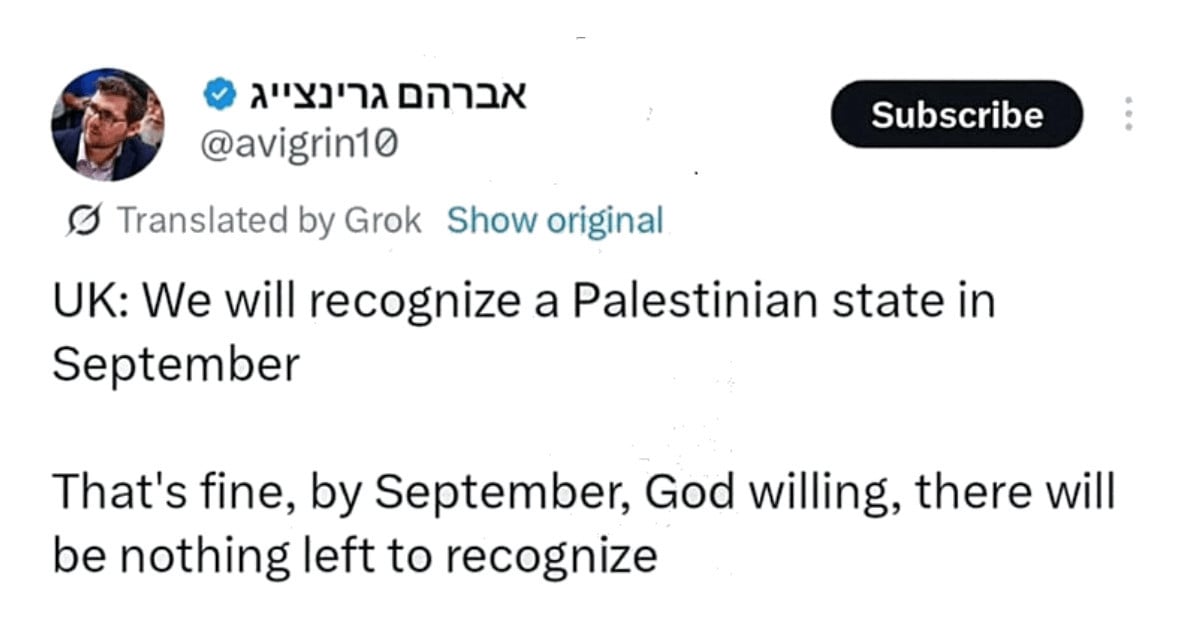
The industrialization of death makes Nazism a unique event in history. Behind it, the inner logic was that there was no choice but to eliminate all people who put the purity of the “Aryan” race at risk. The Nazis had thus convinced themselves that, since it was a necessity, the murder of “degenerated” individuals was also a moral obligation. In other words, their rationale was that their “Final Solution” wasn’t on them; they were just acknowledging facts—the laws of nature, in their ideology—and acting accordingly.
In a tragic irony that is all too familiar in human history, that there is “no choice” is also the point forcefully made by former IDF intelligence chief Aharon Haliva regarding the deliberate and indiscriminate massacre of civilians in Gaza.39 Like any good soldier, Haliva is not in it for himself; he is on a mission for his country. A mission that would make no sense without the basic condition allowing for the disposal of others, which is the belief that the genuine gift of humanity is not universal.
To Hitler, the pseudoscientific veneer of his racial fantasmagory implied as thorough an eradication as possible of inferior races to prevent their “infestation” of the Aryan one. To Zionists, whose racism is a by-product of their colonial nationalism rather than an eugenist ideology, ethnic cleansing is to be limited to what is considered by them as the Biblical frontiers of Eretz Israel. Additionally, their plan does not necessarily involve the physical elimination of Palestinians; if the latter leave their properties to Israeli settlers, they will even be allowed to be forgotten in some bantustans. Only those who want to stay in their homes are to be killed or forcefully displaced.
Unlike Nazi Germany, therefore, Israel has never built massive death camps; like Nazi Germany, however, it denies some others the right to be who they are on their ancestors’ land and leaves them no choice but to flee. This notably echoes the European settler colonial project in North America. There as well, the purpose was to free the land from its previous inhabitants and park in reservations those who weren’t killed. And since you need a good reason to kill people, you’d better make it an absolute one: you are not ethnically cleansing your human sisters and brothers; you are purging the land of undeserving wanderers who have no valid claim to it.
This purpose does not have to make sense. You want the land; this is enough of a reason. This is why the only justification ever given for such an endeavor is out of this world, in the fantastical assumption of a “Manifest Destiny” or God’s direct will. Nothing indeed that mere humans, in the universality of their vocation for happiness and the treasured gift of their cultural roots, can ever truly understand. The drive of settler-colonialism comforts itself in this wilful detachment from reality, making it the natives’ fault if they stand in the way. This is how, for one reason or another, never fully explicitated, they had it coming if the killing ratio must be 1/50, as asserted by Aharon Haliva. That’s the “lesson” Palestinians must learn.
In reality, the lesson must be retrospectively drawn from Nazism, the most complete and extreme ethnic cleansing ever conducted in history. “Never again!” has sounded like the world’s unequivocal cry to return to its senses after the era of Nazi barbarity, but the lesson was not fully taken.
For those who were willing to pay attention, the atrocities committed against “inferior races” in general and Jews in particular were not just cause for a feeling of horror and dread; they clearly underlined the absurdity of white supremacy in all its forms. Unfortunately, Israel was given a pass. Western powers tacitly agreed to consider that moral principles cease to be universal when it comes to the former victims of their long tradition of anti-semitism. This was practicing anti-semitism in reverse. Instead of being persecuted, Jews were now cast aside as people free from accountability. That was the poison pill that Israel’s so-called friends and allies gave to the newborn state and that its Zionist masters were all too eager to take, ensuring the country’s demise of its own making. Not a physical disappearance, but an utter moral wreckage on colonial shores.
It is, indeed, very human to become a Nazi. All we have to do is evade the courage of lucidity and become quietly indifferent to the suffering of others. The emotional factors of being part of a pack and obeying orders will complete the transformation of anyone, when properly supervised, into a killing machine. We should know better, but it is psychologically very tempting to abdicate one’s own judgment, pay oneself with words, and run high on emotions. If, as a consequence, one does not act upon their aspiration for human decency and does not fully understand the roots of human madness, or at least try to, the same delusions and self-generated hatred of the other will produce the same effects. Nazism, in that sense, is not just a historical phenomenon that took place in Germany; it is a sustained collective modality of insanity that will always rise under the right conditions.
In that respect, the smile of Israeli soldiers recording their casual nonchalance in perpetrating war crimes is eerily reminiscent of the smile of their Nazi counterparts in similar circumstances during WWII. The historical context has changed, but the cruelty of so-called soldiers is identical, based on the shared conviction, then and now, that they are doing right by the atrocity of their crimes. That “banality of evil” famously struck Hannah Arendt (1906 – 1975) when considering Otto Adolf Eichmann’s personality during his trial for having been one of the major organisers of the Holocaust.40. To her, it was the definitive confirmation that, far from the Hollywood image of a mythological fight of Good against Evil, it is none other than ordinary men who can easily become monsters in uniform.41 Evil simply needs a good conscience, and IDF soldiers at all echelons have plenty of it.
The other important lesson one can draw from the historical and formal manifestation of Nazism is that the racism at the core of its ideology is not different in nature from the racism indispensable to any colonial endeavor. The novelty with Hitler is that white people were also targeted by the sickness of dividing us into different races. Aimé Césaire (1913 – 2008), the French poet, author, and politician from Martinique, said it best in Discours sur le colonialisme, a pamphlet first published in 1950.42 A man of color, he had an extensive culture and a vivid memory of the wound of slavery inflicted upon his immediate ancestors. This gave him an acute understanding of the fact that the horrors of Nazism had been, in essence, the mere continuation of those perpetuated in European colonies for the sake of racial domination.
Here is a gist of what he had to say:
“First we must study how colonization works to decivilize the colonizer, to brutalize him in the true sense of the word, to degrade him, to awaken him to buried instincts, to covetousness, violence, race hatred, and moral relativism [. . .]”
“Yes, it would be worthwhile to study clinically, in detail, the steps taken by Hitler and Hitlerism and to reveal to the very distinguished, very humanistic, very Christian bourgeois of the twentieth century that without his being aware of it, he has a Hitler inside him, that Hitler inhabits him, that Hitler is his demon, that if he rails against him, he is being inconsistent and that, at bottom, what he cannot forgive Hitler for is not the crime in itself, the crime against man, it is not the humiliation of man as such, it is the crime against the white man, the humiliation of the white man, and the fact that he applied to Europe colonialist procedures which until then had been reserved exclusively for the Arabs of Algeria, the ‘coolies’ of India, and the ‘niggers’ of Africa.”
“What am I driving at? At this idea: that no one colonizes innocently, that no one colonizes with impunity either; that a nation which colonizes, that a civilization which justifies colonization and therefore force, is already a sick civilization, a civilization which
is morally diseased, which irresistibly, progressing from one consequence to another, one denial to another, calls for its Hitler, I mean its punishment. Colonization: bridgehead in a campaign to civilize barbarism, from which there may emerge at any moment the negation of civilization, pure and simple.”
“For my part, if I have recalled a few details of these hideous butcheries, it is by no means because I take a morbid delight in them, but because I think that these heads of men, these collections of ears, these burned houses, these Gothic invasions, this steaming blood, these cities that evaporate at the edge of the sword, are not to be so easily disposed of. They prove that colonization, I repeat, dehumanizes even the most civilized man; that colonial activity, colonial enterprise, colonial conquest, which is based on contempt for the native and justified by that contempt, inevitably tends to change him who undertakes it; that the colonizer, who in order to ease his conscience gets into the habit of seeing the other man as an animal accustoms himself to treating him like an animal, and tends objectively to transform himself into an animal. It is this result, this boomerang effect of colonization that I wanted to point out.”
“I hear the storm. They talk to me about progress, about ‘achievements,’ diseases cured, improved standards of living. I am talking about societies drained of their essence, cultures trampled underfoot, institutions undermined, lands confiscated, religions smashed, magnificent artistic creations destroyed, extraordinary possibilities wiped out.”
The second lesson is, therefore, that Nazism and colonialism are pieces of the same cloth. Putting racism at the core of their political doctrine, they allow, under the guise of “civilization,” that violence against inferior races knows no bottom. Based on pseudo-science, Nazism was racist by design; based on nothing other than greed, prejudices, and lust for power, colonialism is racist by necessity: you do not enslave or dispossess entire populations without seeing them as inferior. But the real wonder about racism is that making no sense is felt as its strongest justification; it is a pretense of rationality whose words exclusively come from the illusion of an “other.” This entity acts like an opposite magnetic field to one’s life and sense of identity. Nothing is defined, questioned, or discussed; working as its own principle, this opposition’s sole purpose is to be the engine of one’s rejection of the designed alien.
Racism cannot be rational, nor reasonable. Of course, the call to reason will be made by its righteous actors to either assess how lenient and humane they are toward their inferior counterparts or to provide explanations for their gratuitous crackdowns against the latter. But these are verbal smokescreens. They only serve to alleviate the conscience of those who need to believe them, while burying deeper in one’s mind the seed itself of racism. Reason is dead for racists; between nice words and violence, there is no room left for its demanding work. On the other hand, if only because it makes one feel right, the seduction of violence has a strong appeal to it. After all, its “lesson” is the only means of communication available with others categorized as a wicked species. It is thus no wonder that Gaza might be the object of an actual genocide, or that IDF soldiers feel entitled to practice shooting at children just for fun—certainly not something they’d do if they thought these had the same human value as children from Jewish families.
Does this mean that Israel is akin to Nazi Germany? To gatekeepers of conventional public decency, the question is anathema. And yet, goose-stepping and the Swastika set aside, this is the same definite moral segregation that has led to the Final Solution under Hitler and the overt ethnic cleansing of Palestinians since 1948. Whichever the pseudo justification of your racism might be, this is still racism. And, once accepted as a social norm, its fruits, regardless of their quantity, are similar to what they have always been. As Orly Noy, the chair of B’Tselem’s executive board, points out, this is notably plain to see in Gaza: “What Israel is doing in Gaza City is not the tragic byproduct of chaotic events on the ground, but a well-calculated act of annihilation, executed in cold blood by ‘the people’s army’ — that is, the fathers, sons, brothers, and neighbors of us Israelis.”43
To this, many outside Israel retort that the unacceptable slaughtering of civilians in Gaza is the responsibility of the fascist government in place in Tel Aviv, and that a large part of Israelis vehemently oppose this government. Unfortunately, these same citizens do not oppose what is being done to the Gazans to the same extent. Far from it: “How is it that, despite the mounting testimonies from Gaza’s concentration and extermination camps, no mass refusal movement has taken root in Israel? That after two years of this carnage barely a handful of conscientious objectors sit in prison is truly inconceivable. Even the so-called ‘gray refusers‘ — reserve soldiers who do not oppose the war on ideological grounds but are simply exhausted and questioning its purpose — remain far too few to slow the killing machine, let alone bring it to a halt.”
As an Israeli herself, Orly Noy courageously looks into the mirror. If enough Israelis significantly opposed what is being done in their name, it could then be said that, unlike Nazi Germany, Israel does not build its project as a country on the bottomless pit of racist violence. Such is not the case: “Who are these obedient souls who keep this system running? How can a society so deeply fractured — between the religious and the secular, settlers and liberals, kibbutzniks and urbanites, veteran immigrants and new arrivals — unite only in its willingness to slaughter Palestinians without a moment’s hesitation?”
Zionism is the answer. Once your ideology sets you apart from the rest of humanity under the pretense of a higher vocation, all you have left to fight for is your separation from others who do not belong to your space. For the absurd sake of purity in the service of your kind, you raise violence to a moral virtue, endlessly persecuting the underseving one(s). To Orly Noy, “What we are witnessing [in Gaza] is the final stage in the nazification of Israeli society.”
Share your thoughts below! (Rules apply)
- About the Author
- Latest Posts

Philippe Roussel has long been interested in studying the power structures defining our increasingly unsustainable and undemocratic world. This website serves as the primary platform where he presents his ideas and findings to an international audience.