

“This is a more personal and subjective consideration reflecting my thoughts on the development of data centers and the need for responsible innovation in a period of great uncertainty about our becoming.” (Bruno Grippay)
By Bruno Grippay. Originally published on LinkedIn, on August 24, 2026.
I was wrapping up my master thesis on the sustainability of data centers, when I was distracted by my wife who suggested going to a nearby cinema to watch the latest documentary of Vincent Munier, a French wildlife filmmaker: “Whispers in the Woods”. It proved to be a delightful moment of enchantment and wonder. As we walked out of the dark theater, I kissed my partner tenderly to celebrate this marvelous break from my laborious drafting work.
All along the evening, we continued to discuss the movie and its beautiful landscapes, the exceptional sceneries capturing animals through the lens of the camera, as well as the touching relationships between the grandpa, the dad and the son in their quest to rediscover a lost bird species in the misty forests of remote mountains. The wisdom of the older man was particularly enlightening, and I will take the liberty of quoting some of his insightful comments into this article.
At some point during our conversation, I was struck by an incongruity. From my side, I spent hours and hours investigating the development of data centers, which are the physical infrastructure to foster artificial life throughout our existence in all its dimensions. From their side, these three members of the same family dedicated days and nights to remain still and silent, lost in mountaineering woodlands, in awe of natural life. I was suddenly seized by an itching desire to write about this discrepancy.
During these months of writing my thesis, I was lucky to benefit from the support of a remarkable tutor, Xavier Pavie, philosopher and professor at ESSEC Business School, whose passion for stoicism and spiritual exercises couldn’t bring me greater jubilation.
This confluence of factors offered me a nice opportunity to elaborate on these three very different approaches and enjoy intertwining them: the brutal expansion of data centers as the foundation for artificial life, the respectful and precious bond for natural life, and the need of stoicism as an anchor for spiritual life.
The rule that I applied to myself in this article was not to share any metrics on data centers. I commented many of them in my thesis and the internet is full of comparisons and evaluations on emissions, energy and water consumption, power capacity, cost per unit, land occupancy, pollution… This is not the battle that I want to fight here. I wish to bring another perspective that I could not address fully in my research because of the obligation to remain factual and objective as much as possible. This is a more personal and subjective consideration reflecting my thoughts on the development of data centers and the need for responsible innovation in a period of great uncertainty about our becoming.
1. The Cloud as an Ethereal Metaphor
We are inclined to believe that Artificial Intelligence (AI) is a dematerialized technology. It seems to be an evanescent, light and soft innovation, acting like a human brain. This misleading feeling is rooted in the promotion of the term “cloud computing” to designate all the servers for IT applications and AI models. In fact, this terminology was used on purpose and turned out to be a smart marketing idea to boost public adoption for these cloud-based services and make it a user-friendly transformation. This trick was denounced by Nathan Ensmenger in the first chapter of the collective book from the Massachusetts Institute of Technology Press, “Your Computer is on Fire”, edited by Thomas S. Mullaney, Benjamin Peters, Mar Hicks, and Kavita Philip: “In rendering invisible the material infrastructure that makes possible the digital economy, the metaphor of the Cloud allows the computer industry to conceal and externalize a whole host of problems, from energy costs to e-waste pollution. But the reality is the world is burning. The Cloud is a factory. Let us bring back to earth this deliberately ambiguous and ethereal metaphor by grounding it in a larger history of technology, labour, and the built environment, before it is too late.”
Studying the development of data centers is essential because they are the backbone of this infernal machinery intending to immerge all of us in a fake and simulated society. The physical manufacturing of this technology extends its influence in major steps of the value chain, starting from the raw material extraction and mining, to the industrial energy production, the fabrication of IT components, chips, racks and mechanical systems, until the e-waste generation. There is no way to get full visibility on the whole life cycle impact of these industrial processes. The main actors and communicators from this sector take a wicked pleasure in drowning people in multiple data, indicators and other gibberish technical jargon to hide their negative impact on the environment.
I have no doubt that hyperscalers, powerhouses and other developers strive to invest in research and innovative technical solutions to reduce their environmental footprint as much as possible, through energy savings, industrial symbiosis or closed-loop cooling systems. However, the upfront investment cost might often be an excuse to turn down these sustainable improvements. Nonetheless, externalities remain significant and cannot be reduced easily. For example, the risk of rebound effect which will maintain high levels of energy and water consumption despite the better efficiency of the facilities; the need for diesel backup generators to ensure 24/7 service level that produce significant air pollution; the heat island effect which was recently evaluated by researchers to persist several kilometers away from a center; the large surfaces of land which are confiscated at the detriment of other agricultural or industrial activities; or the waste contamination of short-life e-components that will not be properly recycled.
A common practice is to present indicators at a global level to undermine the overall impact of data centers on the planet. This global perspective is meaningless, because the consequences on the environment are always local. Some other tactics are to exclude portions of the process to showcase nice performances on power and water efficiency, to ignore ostensibly the indirect consumption from related activities to support the demand (such as power stations).
If we had to focus on one major factor of limitation for data center, it would be the power capacity. They need much more electricity than many grids in the world can supply. Hence, this is the explanation to the crazy appetite for the implementation of sustainable power solutions. So much is at stake in this exponential business development that the risk of bribery is a real threat. Some projects are swirling with rumors accusing stakeholders to leave megafires burning forests and vegetation to free up lands for future implementation of AI data centers and some of their production stream (mining, wind and solar farms, IT parts manufacturing). In a sensible world, I would have immediately rejected these kinds of conspiracy theories. However, transparency is not a common practice in this sector. It seems that, without noticing it, we are falling progressively in a rapacious society where the rapid ascent of AI monetization generates high financial expectations which took over our restraint and moderation. I feel a terrible pain and a bit of a desenchantment in believing that it might be true.
Isn’t it astonishing to listen to our famous techno-utopian eccentrics claiming that humanity will conquer planet Mars or will exploit very soon the resources on asteroids, that their disruptive technology will surpass our human intelligence in five years and take full control in ten years, and find enough people to give credit while admiring them as the wiser prophets on earth? They succeeded in instigating a court of sycophants who gravitate around them like satellites to catch within their nets all the productive and corruptible forces across the economic and political spheres. In such a world governed by stock market speculation and gullibility at every floor, everything can become possible including the discarding of values of integrity and responsibility.
I believe and wish that reasonable citizens will look at this shit show with skepticism, although they cannot influence it and remain powerless in front of this flood of ambitions. We are all swept up in a collective madness. I imagine that the historians of the future will take great pleasure in studying this speculative frenzy that will have carried us very far, though we do not yet know how far.
In the meantime, I could find no better remedy than to rely on our ancient philosophers and some modern thinkers who continue to teach us their timeless life lessons. This gives me a tremendous sense of comfort, allowing me to hold on to hope and observe with delight the evolution of this great experience of humanity.
2. The Cloud as a Nuance of Thoughts
Stoicism is a captivating school of philosophy. For a neophyte, this doctrine could appear as quite simple, but then he would realize quickly how difficult it is to put its principles in practice. On multiple occasions, I immersed myself with relish in the treatises of Seneca, Epictetus or Marcus Aurelius, and valued the intricate nature of their inner thoughts. My humble aspiration of acting like a Stoic were often mocked by my family and became their laughingstock whenever I happened to lose my temper at the wrong time. I know that I am not a model of temperance, which is one of the four main virtues of Stoicism alongside wisdom, courage and justice, however I always feel rewarded when reading the books of its main representatives hoping that I can improve my behavior day after day, following their suggestions.
Ten years ago, a group of passionate philosophers based in Philadelphia (US) created a worldwide network to connect communities of Stoics around the world, the Stoic Fellowship. Amazingly, they were able to gather dozens of organizations spread out on the five continents, including a French-speaking one, the Stoa Gallica. This latest one was created by a young Swiss philosopher, Maël Goarzin, who published on internet his thoughts during the years of his doctoral studies in a blog called “How to live everyday”. I enjoyed reading his comments and it is thanks to him that I studied with extreme attention the “Discourses” from Epictetus and the “Letters to Lucilius” from Seneca. I took many notes from these lectures and, for sure, one day I would love to dedicate an article of this series to their outstanding teachings.
It is also to Maël Goarzin’s credit that I learned about the professor Xavier Pavie. It turns out that they collaborated on several podcasts, public roundtable events, academic seminars on stoicism and spiritual exercises. They even published a book to share experiences on how to live like a philosopher (only available in French so far). This is the reason why I was so positively surprised and enthusiastic to undertake my master thesis under the guidance of this professor.
Initially, my scope of investigation was rather large with a scientific literature review of circular economy and industrial symbiosis followed by a study on the application of these sustainability concepts in the development of eco-industrial parks. From the very beginning, my tutor suggested I narrow down my research while including another dimension related to the concept of responsible innovation. Xavier Pavie is well known for being an expert on this topic as he edited two books and several scientific papers to investigate this matter. I followed his recommendation to add this third sustainability framework and decided to focus on the expansion of AI data centers, particularly in the Middle East.
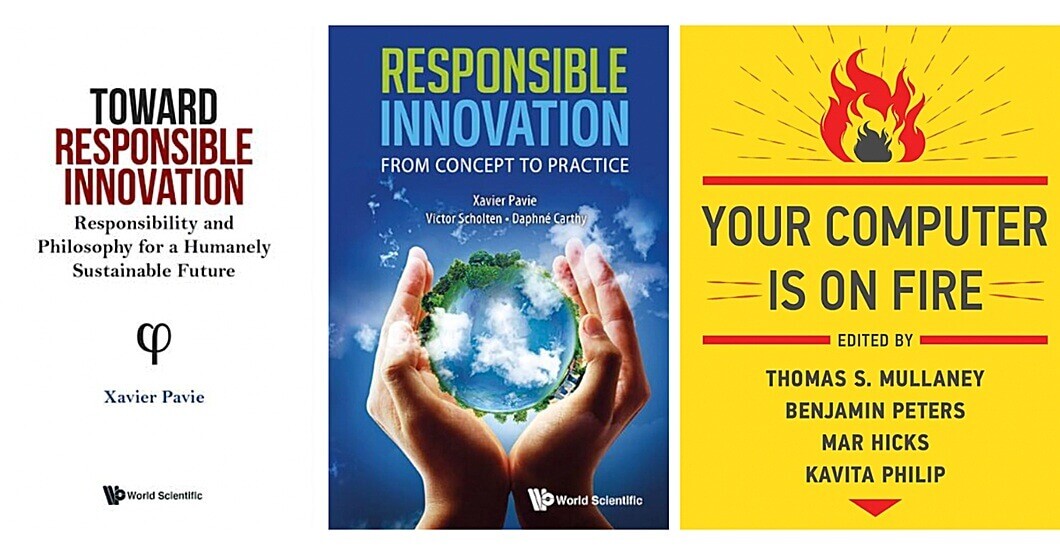

To get more familiar about the meaning of responsible innovation, I read his publications and a few other academic articles. I was pleased to realize that its content and underlying principles would apply perfectly to the core of my research. Responsible innovation means “taking care of the future through collective stewardship of science and innovation in the present”. The main ambition is to evaluate innovations from the perspective of doing good and do not harm the people and the planet for now and for the forecasted lifespan of the invention. It has “to improve living conditions and safeguard the earth’s life-support system”. Its moral and ethical dimensions are essential. By applying the principles of this concept, we should be able to evaluate the long-term impacts of an innovation, carry a critical and reflective analysis of its ambition and perspective of business, involve third parties and non-expert citizens to provide inputs and have the capacity to change direction and adapt the project accordingly.
Xavier Pavie (with his co-authors, Daphné Carthy and Victor Scholten) went one step further and proposed a system of governance to ensure that these principles are implemented under a set of rules and manageable considerations: “The issue at stake for such governance would be, on the one hand, to maintain a certain tension between the innovation which is in circulation on the market and the continuous progress in scientific knowledge and that should be brought to the attention of users in terms of consequences. On the other hand, it would ensure that a particular innovation would indeed be aimed at benefitting society as a whole rather than a fraction of citizens.” I liked this pragmatic approach and decided to apply it to the development of data centers and, by extension, to the AI systems which are intrinsically related to this infrastructure. Let’s review these conditions one after the other.
First principle, the Common Good: “Does the innovation place the community at risk?” When the AI models intend to bring positive outputs to the society, such as preventing diseases, disabilities, tackling climate change, accelerating scientific research or providing education services, we should fully support the deployment of the data centers that will store and manage the data associated with these objectives. While AI might strip away part of our individual intelligence, we should capitalize on it to improve our collective brainpower. It could become a tool to enhance our energy of action as a group. We would develop our work together towards the common good, the harmony between humans and with nature, the regeneration of damaged ecosystems or the geopolitical conflict resolution. However, if the AI models are designed to generate unethical processes, miscommunications, disturbing behaviors, military applications, malicious intentions or misleading outputs, there should be a way to oversight these development and mitigate societal harm.
In an article from the MIT Technology Review, “The Data center boom in the desert”, the author James Temple brings an interesting case on stakeholders’ engagement, often missed when we talk about freshwater usage for data centers, which is the impact and connection with local communities. It is quite an important factor that is recognized as a major risk by the International Finance Corporation (IFC) in their Performance Standards. The author sets his example in Sierra Nevada (US). There is an ancient law that gave imprescriptible rights to a local Tribe (The Pyramid Lake Paiute) to water for the irrigation of their land. But the tribe has been fighting to protect their rights ever since, “arguing that increasing strains on the watershed from upstream cities and businesses threaten to draw away water reserved for reservation farming, decrease lake levels, and harm native fish”. I really like the message from the chairman of this Tribe, Steven Wadsworth: “It’s completely tied into us as a people. That is what has sustained us all this time. It’s just who we are. It’s part of our spiritual well-being.” This issue with local communities should not be underestimated in the development of data centers in the future.
Second principle, the public and the users must take part in the decision-making process: “Have the users got the means needed to understand and decide?” Fighting against the implementation of a data center for environmental reasons is of course necessary but cannot be sufficient. The citizens must be involved and request a clear debate and understanding on how the data is managed and stored in the center and how it will be used, in the objective that it has to be for the ‘common good’. This appreciation by the public could have a side educative benefit in helping them to understand the environmental impact of the usage of AI in their private life.
In his book on responsible innovation, Xavier Pavie draws a fascinating connection between two philosophers: the Spanish José Ortega y Gasset and the American Ayn Rand. He explains that Rand stretched the idea of Ortega y Gasset’s “innovator as an excellent man” to the extreme in considering that an innovator could do whatever he wants and be only governed by “rational selfishness” and concerned by his own interests. Ayn Rand’s philosophy, as a moral defense of individualism, would not care about the consequences of a data center on the rights of the Pyramid Lake Paiute Tribe. According to her perception of the world, these claims would be totally meaningless. The land and the resources belong to those who can exploit them, to those who are smart enough to innovate, to “produce”, to bring more value to the neoliberal society. In her mind, the entrepreneurs should be protected from state interventionism, which is quite the opposite of the responsible innovation concept.
Third principle, research and results must be published: “Is the progress and evolution of knowledge being shared by and with all?” On this aspect, there is clearly a gap as scientific publications on data centers’ impact remain too limited. This industry should be investigated at a larger scale on the three sustainability dimensions of circular economy, industrial symbiosis, and particularly responsible innovation. There is much debate about responsible and ethical AI, but it is barely linked to the massive physical infrastructure required to handle all the prompts that users are addressing to these models.
Fourth principle, impacts must be measured independently: “Who owns the knowledge? In other words, we should aim at achieving a type of governance which is not attached to any financial interest concerning stakeholders.” There are standard metrics to measure the performance of data centers, like the energy and water usage efficiency, but the calculations are processed internally without transparency. It is easy to select and present figures in a certain way and pretend to achieve high level targets which are not consistent and comparable with others (I found that Google is particularly clever in this smart reporting adjustement). Without any third part validation, it will remain impossible to trust the information provided by the data centers.
Fifth principle, the setting up of governing bodies should precede the launch of innovations: “Is every innovation project — which is considered to be potentially “at risk” — being correctly launched in terms of a surrounding and appropriate system of monitoring and governance?” We cannot expect the AI hyperscalers to limit themselves in their technological development because they are engaged in a harsh global competition for innovation and leadership. We can regret it, but there is nothing we can do about it. We are in a wild and savage rivalry between global players that tends to put aside their ethical considerations. The risk is to see data centers mushrooming everywhere with the complacency of local authorities and an open avenue for major corruption and immorality. This principle provides a nice intention but it is like shooting in the dark; it offers very little control over the building of data centers all around the world.
Xavier Pavie defends responsibility against the selfishness promoted by Ayn Rand. This is exactly what should be at the heart of the actions from government representatives and regulators. They should also be involved in evaluating with a critical eye the projects of data centers and apply this proposed governance for responsible innovation with a particular focus on the impact for future generations. We cannot expect that this essential critical assessment on the implementation of new data centers will be made by the entrepreneurs themselves. It is always good to get an objective, third-party look at our projects, because we are all, to a certain extent, blind and carried away by our personal ambitions. It is not specific to business people, and I found funny to read a similar comment from Xavier Pavie on his philosophical community: “The solitude of the hero needs to be put in perspective with their ego, their narcissism. The Philosopher and the Entrepreneur are driven by the strong belief that they hold the truth.”
In summary, responsible innovation should promote an approach fostering the ‘common good’ evaluation, the involvement of public and government, the transparency of the performance and the objective measurement of the impacts by third parties. This is where these principles find their importance and high relevance for data centers, because such infrastructure should not be treated independently from the expected usage of the data that they store and manage. The quality of the data collected, and the processing purpose are at the foundation of an ethical consideration for AI development. It will not be enough to tackle the environmental issues of data centers, through circular economy and industrial symbiosis improvement, because we will forget to address the initial question of whether we need to store and process this data in the first place. The answer to this issue relies on a moral and societal question that cannot be left at the discretion of global tech giants. It must be controlled by public authorities, regulators, citizens and other independent stakeholders, who will evaluate the ultimate goals of these processes and judge whether or not they provide improvements towards the ‘do not harm’ and ‘do good’ for society, in an intention well-aligned with the dimension of responsiveness in the responsible innovation concept.
However, after reviewing these five conditions, I think that we are still missing one important factor about the relationship between AI and us, particularly when we think about the GenAI models. They appear to provide quite a few emotional services for users. When an AI-powered chatbot, like ChatGPT, interacts with us, it is always responding in an empathetic and positive mode. The system will keep replying endlessly and never be furious or negative, something that is barely possible with humans’ interactions. In a sense, GenAI could become the best companion of those users who have difficulties communicating with other people. We might even end up in a situation where the AI models would drag these influenceable people into loneliness with a risk of manipulation and domination. This is a real risk that would break the way our societies work together in the future if we don’t pay attention to it. Again, we cannot expect the AI corporate owners to act on it, because it is a key factor for their business development. They might improve the power of their innovations by reinforcing this opportunity to subjugate their users.
Here, the concept of responsible innovation and governance gains its full meaning for collective integrity. At an individual level, the practice of philosophy, like the Stoic spiritual exercices, might help us escape from the hold of these GenAI powerful and emotional systems.
3. The Cloud as an Earthbound Element
One of the letters from Seneca to Lucilius is particularly interesting to appreciate the risk of losing contact with the natural environment. It is the letter 41 entitled “On the God within us”. Seneca’s overall message is that wisdom abides inside of us. We need to cultivate our own values and not waste our time looking for external guidance through idols or prayers. But, in the middle of the letter, he takes the imaginery of a dense forest and writes the following: “If ever you have come upon a grove that is full of ancient trees which have grown to an unusual height, shutting out a view of the sky by a veil of pleached and intertwining branches, then the loftiness of the forest, the seclusion of the spot, and your marvel at the thick unbroken shade in the midst of the open spaces, will prove to you the presence of deity.”
At a first glance, this metaphor seems contradictory with the message, because if there is a deity in the deep forest, how could we pretend to carry the true wisdom inside ourselves? Here is a typical subtlety of Seneca’s philosophy. In fact, the beauty of the nature acts on us as an intercessor to reveal the importance of our soul. The emotion we feel is beyond all the external and material satisfactions that we could get from the others and the society. Our intense feeling in front of the wonders of nature is the manifestation of the wisdom that we carry within ourselves.
The clarity and deepness of this message made me feel that my mind was expanding to the infinity. This is such a wonderful and fulfilling emotion. It reinforces the imperative necessity for us to protect our contact and relationship with nature, and reject with force all of these siren songs of AI that seek to beckon us in desperate and void spaces.


This might be the reason why the documentary “Whispers in the Woods” is so poignant. The three men cross the great forests of the Vosges region, in the eastern part of France, looking for a bird, the capercaillie, who lived there for thousands of years but disappeared recently because of our disturbance and the ecological disruption. They barely talk together. They just admire the nature around them. One evening the grandpa gives a simple life lesson to his grandchild: “You must keep being awed. As long as the sun rises, as long as a bird sings, as long as a flower blooms, we must keep going.”
I would like so intensely that these words could be heard by all those who are caught in their fascinations for AI universes which will never give them the tiniest portion of the happiness that the sight of nature can bring us. “For me, the saddest thing is not the bird dying out, it is precisely the human mindset of not caring.”
There is something else that this wise man is teaching us. Far from the AI systems that bind us to dependency and despair, nature always allows us to restore faith and joy at every moment: “Because of the end of the capercaillie, I was sad, but the wonderful thing is that, at one point, in front of me, there was the smallest bird, the wren, which is the total opposite. A wren weighs as much as a walnut, 9 grams. It was there saying: “Are you mad? You are bothered about that bird, and I am here singing. I exist too!” That wren cheered me up and made me realize that something insignificant, messages that are timid and discreet, are often the ones you should heed, because they carry hope. (…) Here, everything is an eternal cycle. Those young conifers that plunge their roots in their ancestors. Even when it is dead, a tree keeps giving life. We are born, we live, we die to participate in the overall movement. Our origins are there, in the humus. Even the capercaillie that has disappeared from our mountains, for me, it is there. I feel its presence all over these forests. All those vibrations resonate discreetly within us, and inspire us, like a breath. We are in what passes.”

This confession imbued with humility and hope is heartwarming. I fear that our frenetic rush toward more AI is leading us astray. Look at this wren, a whole life in 9 grams. Look at this tree, a whole life motionless interacting with its siblings. Look at this human being, a whole life with a brain of 20 watts. No matter how much we will blanket the earth with data centers, opencast mining, energy clusters or e-waste dumping grounds, we will never reach even a small portion of the vitality and the generosity of the natural life. In this dead-end race, we forget the values of silence and stillness taught by nature, which AI seeks to steal away from us.
I remain haunted by the narrative from Erich Maria Remarque, “All Quiet on the Western Front”. This accounting of the cruel experience of a young German soldier sent to the horrific battles on the front line are deeply engraved in my mind. I remember those shivers of dread down my spine and the sobs I could not hold back while discovering the sorrows that men inflict upon themselves. Reading this book was like a tear in the veil of innocence I so naively wore upon this world. This semi-autobiographic novel never ceased to trouble me because it exposes our destructive rage when no safeguards remain against technological dominance, greed for power and delusions of grandeur. I am convinced that there is a lesson to be learned somewhere from this tragic devastation about tempering our consuming enthusiasm for AI.
We need to hear the voices of those who have nothing to sell, no performance indicators or economical ratios to provide, only their emotion of living and their desire to protect their loved ones and the surrounding nature.
The following testimony is from Michel Bernard, a French author who published several novels around the personalities of the painter Claude Monet and the historic heroine Joan of Arc novels. He is another voice to hear. One day, in a regional newspaper, he expressed his wistfulness about the stolen grace of his surrounding nature in his style elegant and polished which was beautifully translated from French by Laurent Bury: “I live in one of those French departments where wind generators are pullulating. Some of the landscapes I had known since childhood have been defaced. When I walk across them, my soul inevitably feels broken as I try to remember how comforting the free gift of everyday life used to be there: a view of the beloved country. Wind turbines are not ugly in themselves, but in their relationship with the environment in which they have been erected. Their proliferating gigantism shatters the proportions to which we have been accustomed from birth and from generation to generation, everywhere. In their vicinity, the mightiest oaks are dwarfed into ridiculous insignificance; a forest turns into a rough carpet, a river into a brooklet. Machines humiliate whatever in nature inspires us with a sense of grandeur, majesty, nobility and the eternal force of life. The unease experienced when passing through these bristling expanses has no other source. It is an uprooting of the human gaze.”
Michel Bernard weaves a contradiction between our growing need for clean energy to fuel our facilities and our timeless need to maintain a spiritual communion with the nature around us. I see a connecting thread between his thoughts, the words of Seneca and those of the grandpa from the Vosges mountains.
The last voice that I wanted to share here was offered unintentionally by Brad Evans, professor of Political Violence & Aesthetics at University of Bath, who is working on an essay on Vasily Grossman to be published next year (I look forward to it!). He considers that Grossman’s master work, “Life and Fate”, written back in 1959, is one of the most important book of the twentieth century, which I wholeheartedly subscribe to. In one of his recent posts, Brad Evans pasted one short chapter of this masterpiece which creates a surprising chord to our topic, giving it a stirring touch, although the author was referring to a completely different and dramatic context, the horrors of fascism and the extermination camps:
“An electronic machine can carry out mathematical calculations, remember historic facts, play chess and translate books from one language to another. It is able to solve mathematical problems more quickly than man and its memory is faultless. (…) It will be able to listen to music and appreciate art; it will even be able to compose melodies, paint pictures and write poems. Is there a limit to its perfection? Can it be compared to man? Will it surpass him?
Childhood memories… tears of happiness… the bitterness of parting… love of freedom… feelings of pity for a sick puppy… nervousness… a mother’s tenderness… thoughts of death… sadness… friendship… love of the weak… sudden hope… a fortunate guess… melancholy… unreasoning joy… sudden embarrassment…
The machine will be able to recreate all of this! But the surface of the whole earth will be too small to accommodate this machine – this machine whose dimensions and weight will continually increase as it attempts to reproduce the peculiarities of mind and soul of an average, inconspicuous human being.”
Bruno Grippay
Passionate about the link between sustainability, mobility, and modern living. For the past 10 years, I have focused on advanced mobility solutions like Electric Vehicles, autonomous solutions, connectivity and car sharing. I pair this tech expertise with deep ESG strategies, including materiality assessments, climate change issues, and stakeholder engagement. Outside of work, I am deeply fond of literature, history, and philosophy.